
Parent and adolescent conflict
Escalations, shutdowns, and standoffs over autonomy, school, screens, or safety that have outlasted every consequence and every heart-to-heart.
Alireza Ehteshami, Ph.D.
Family therapy · Atlanta, Georgia
Family therapy brings the people involved into the same room, so that the pattern between them—not one person’s behavior—becomes the thing that changes.
The initial consultation is free and typically lasts 15 minutes. I will respond within 24 hours.
Pre-Licensed Professional in Clinical Psychology · Services provided under licensed supervision

Your clinician
I earned my Ph.D. in Clinical Psychology from Emory University and practice at Perimeter Mood & Anxiety Program in Atlanta.
I am a Pre-Licensed Professional in Clinical Psychology, practicing under the supervision of Craig Kerley, Psy.D., Georgia license PSY002840.
The practical details
The initial consultation is free and typically lasts 15 minutes. I will respond within 24 hours.
We can discuss what you are looking for and whether my approach may be a good fit.
Request a free consultationFamilies usually arrive after a long stretch of managing: a teenager who has gone quiet or explosive, a parent and adult child who cannot talk without it turning, siblings divided over an aging parent’s care, or a household where conflict has simply become the weather. Each person can usually explain, accurately, what the others are doing wrong.
Family therapy starts from a different premise: the problem is rarely one person. It lives in the sequence between people—who reacts to whom, what gets said and what gets withheld, which roles have hardened over years. Bringing the family into the room makes that sequence visible, and a visible pattern is one that can change.
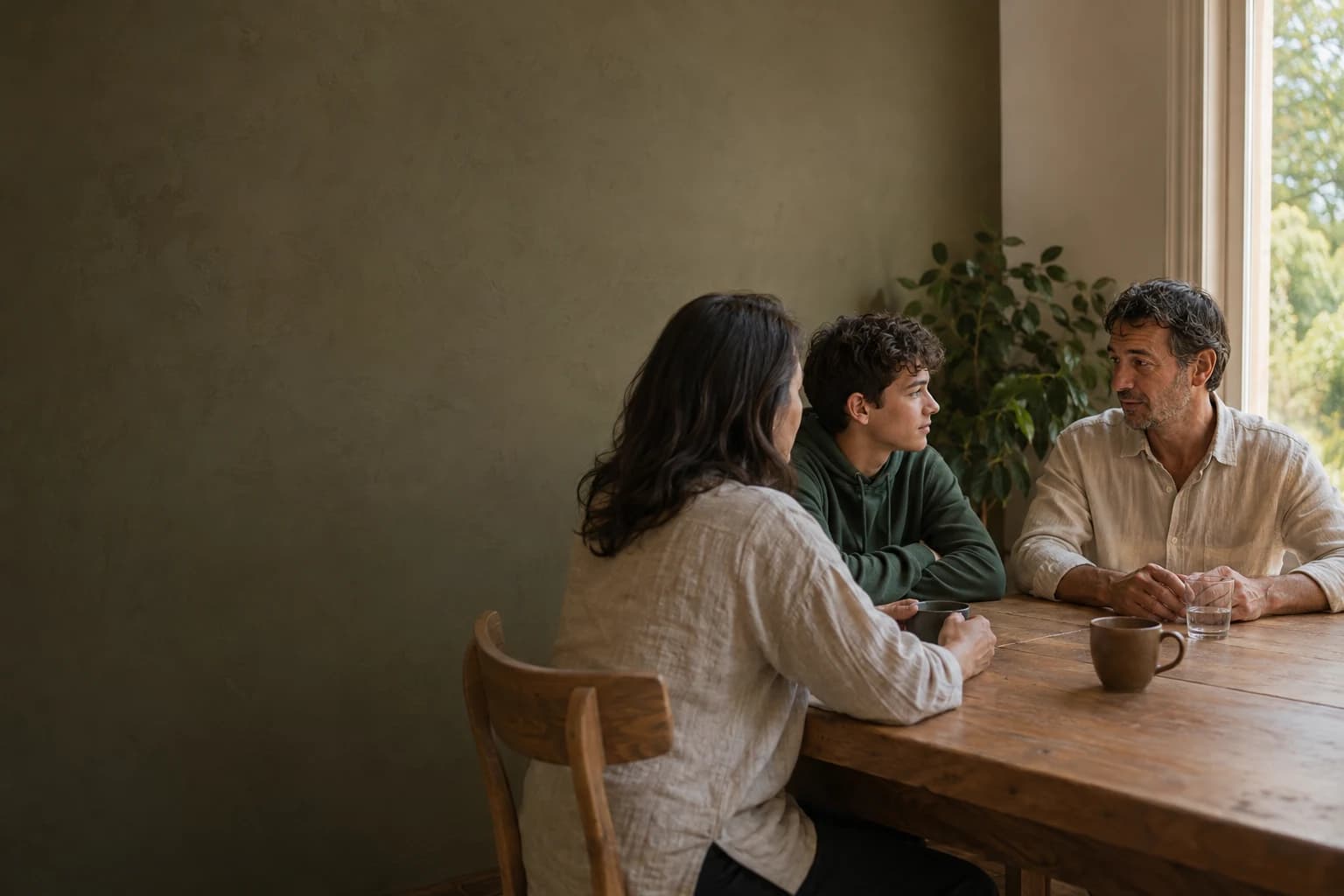
Sessions include the family members involved in the pattern, in combinations that fit the situation—sometimes everyone, sometimes a parent and a child, often shifting as the work develops.
Escalations, shutdowns, and standoffs over autonomy, school, screens, or safety that have outlasted every consequence and every heart-to-heart.
Estrangement, resentment, or communication that breaks down between adult children and parents, between siblings, or across generations under one roof.
Divorce and blended families, illness, loss, relocation, or one member’s mental health difficulties reshaping how the whole family functions.
Structured, even-handed, practical
I work with families in a structured, systems-informed way, drawing on evidence-based approaches from my training in adolescent and adult treatment—including the family components of DBT, behavioral parent training, and CBT-based communication and problem-solving skills. Sessions are active: we look at how a specific recent conflict actually unfolded, practice a different exchange in the room, and agree on what each person will try before the next meeting. When individual therapy for one member would serve better, alongside or instead of family work, I will say so directly.
Each person is heard without being managed, and no one is cast as the problem—including the family member everyone else has already cast.
We map how difficult moments unfold step by step, so the family can see where a different move would change the outcome.
Change happens in exchanges, not explanations. We rehearse the hard conversation with everyone present, then take it home.
Training & supervision
I earned my Ph.D. in Clinical Psychology from Emory University and completed an APA-accredited predoctoral internship through Emory University School of Medicine’s Child, Adolescent & Young Adult Psychiatry program.
I am completing a postdoctoral fellowship at Perimeter Mood & Anxiety Program. I draw from evidence-based treatments including CBT, ACT, and DBT, selecting methods according to each person’s needs rather than applying a single formula.
Common questions
The people involved in the pattern we are working on—which may be the whole household or two members at a time. We decide this together at the initial consultation and revisit it as the work develops. Adolescents and adult children take part as full participants, not as the subject of the sessions.
It is common, and family work can still begin with those who are willing. Patterns are shared, so a change in how one or two members respond often shifts the whole system—and reluctant members sometimes join once they see that sessions are not a tribunal.
This page describes family therapy—work with parents, children, and adult family members on the patterns between them. If what you are looking for is couples therapy specifically, the initial consultation is the place to discuss whether my work is the right fit.
Parent-focused work meets with parents alone and gives them tools to change a child’s behavior through their own responses; it is a strong fit for younger children and for parents who want concrete strategies. Family therapy brings family members into the room together and works on the exchanges between them. The consultation helps us choose the better starting point.
Request a consultation
The initial consultation is free and typically lasts 15 minutes. I will respond within 24 hours.
Share a few scheduling details below to request an initial consultation. This form intentionally does not ask for clinical or medical information.